

Summary
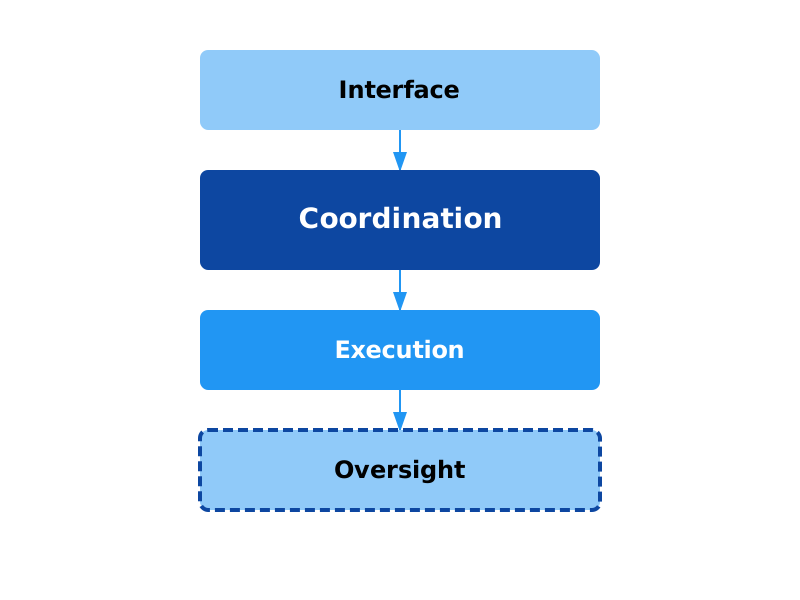
A digital workforce connects interface, coordination, execution and oversight. Learn the four-layer model and where real-world deployments can break.
What Defines a Modern Digital Workforce?
A digital workforce is a coordinated system of AI employees, intelligent agents, APIs, UI automation and human judgement that works together to execute organisational tasks. Unlike isolated AI tools, a digital workforce connects these capabilities around shared intent, allowing work to move from request to execution with defined roles, automation and human oversight.
Isolated AI tools operate on a single prompt-and-response cycle. They generate text, summarise a document or write a code snippet. They wait passively for the next human command. They do not retain context across long-running business processes. They do not interact with a broader ecosystem of specialised systems to achieve a final goal.
A digital workforce is designed to execute multi-step work across time. A resilient workforce architecture should allow the system to manage its own dependencies. A resilient workforce architecture should be able to pause for human input when uncertainty arises. The design should accommodate handling system exceptions during data entry and resuming operation once an error is resolved.
To understand this structural shift, operators can compare a digital workforce with established automation categories:
| Technology | Core Function | Adaptability | Human Role |
|---|---|---|---|
| RPA | UI-based static automation | Breaks when rules or interfaces change | Human triggers and maintains |
| iPaaS | API-based data routing | Works well within defined integrations | Human builds and maintains workflows |
| Single-Agent Copilot | Assists a human with tasks | Highly adaptable to prompts | Human remains the executor |
| Digital Workforce | Coordinates multiple capabilities to execute work | Can adapt across systems, exceptions and roles | Human supervises and intervenes where needed |
These categories overlap in practice. An RPA script might trigger an iPaaS workflow. A digital workforce might employ both to complete a single task. The distinction lies in the architectural approach. A digital workforce treats these technologies as individual capabilities within a broader execution engine, rather than relying on them as standalone solutions.
A Digital Workforce Operates Across Four Layers
Viewing AI as a monolithic block can stall deployment. A practical approach separates the system into distinct operational components. The Four-Layer Digital Workforce Model provides a structural framework for designing and managing autonomous operations.
Interface
The interface layer is where work enters the system and where final outcomes are returned. This is the boundary between human intent and machine execution.
Interfaces take many forms depending on the operational context. Employees submit requests through natural-language chat applications. Enterprise systems trigger processes via API webhooks. Operations managers initiate and monitor work through dedicated dashboards.
The interface captures intent. It provides the initial parameters required to begin a process. However, the interface is not where the workflow executes. Confusing the chat window with the execution engine is a common architectural error. An interface is merely a mechanism for data entry. Real work requires a deeper system to translate that intent into action.
Coordination
The coordination layer acts as the management function of the digital workforce. When an objective enters through the interface, the system must decompose that request into discrete tasks and route them accurately.
This layer sequences the operation. It determines which tasks must happen sequentially and which can run in parallel. If a user requests a vendor onboarding process, the coordination architecture identifies that it must verify tax documents, create an ERP record and send a welcome email. It routes document verification to a vision capability, ERP entry to an API integration and email drafting to a language model.
The coordination layer is the system layer that connects people, AI employees, agents, APIs and interface-based automation around a shared organisational intent. It assigns roles, sequences work and manages collaboration so that individual capabilities operate as one coordinated digital workforce rather than as disconnected tools.
Execution
The hard part of deploying AI is not only making the system intelligent. It is making it reliably execute work across the systems an organisation already depends on. This happens at the execution layer.
Execution occurs across APIs, SaaS applications, databases, codebases, spreadsheets, enterprise portals and legacy systems. A core principle of robust execution design is the last mile: APIs when available, UI automation when they are not.
APIs offer a stable programmatic method for systems to interact. However, real organisations cannot assume every system has a clean API. Many legacy customer relationship management (CRM) platforms and customised enterprise software deployments do not expose the necessary endpoints. Even modern SaaS applications restrict API access behind premium tiers or rate limits.
To operate effectively across these environments, a digital workforce architecture must navigate these restrictions. UI automation enables AI systems to interact with software through its user interface when direct API access is unavailable or insufficient. It allows digital workers to operate legacy applications, spreadsheets, portals and other systems as a person would, making non-API systems part of the executable workflow.
UI automation can be a fundamental requirement for real-world execution when critical systems lack usable APIs. Human workers interact with software primarily through graphical user interfaces. If an automated process aims to execute those same tasks, the architecture must accommodate the ability to read screens, click buttons and enter text. This approach ensures no process is blocked simply because a vendor failed to provide an API or a database lacks a standard integration.
Oversight
The oversight layer governs the actions of the digital workforce. It is an intentional design layer. Autonomous systems will encounter ambiguous situations, incomplete data and high-risk decisions. The oversight layer provides the control mechanisms to handle these scenarios safely.
A robust system design should implement policy checks, data validation routines and risk-based approval thresholds. It is designed to evaluate the outputs of the execution layer before those outputs affect production systems. If a workflow drafts a high-value financial transaction, the oversight architecture can require that action to be flagged for review.
A critical component of this design is the escalation path. Human-in-the-Loop is a collaboration model in which people participate at defined points in an AI-driven workflow where human judgement, approval or intervention is required. Kovok treats these checkpoints as part of system design, allowing organisations to balance autonomous execution with appropriate human oversight.
Low-risk work can be automated entirely. Structured data entry or routine report generation might not require a human. Higher-risk or ambiguous actions can require validation or approval. When a workflow reaches an uncertain state or attempts an action exceeding its designated risk threshold, the architecture pauses execution and escalates the decision.
Where Digital Workforce Deployments Break: Execution and Oversight
Moving autonomous systems from proof-of-concept to production can be challenging. Execution and oversight are frequently under-addressed compared with the intelligence layer. These problems tend to cluster around three areas.
The Intelligence Trap
Engineering teams can fall into the intelligence trap. Focus is placed heavily on model selection, prompting strategies, reasoning frameworks and benchmark performance. A project might centre on evaluating whether a language model can pass logical reasoning tests or generate perfectly formatted JSON.
Having an intelligent reasoning component is not the same as having a reliable operational system. An architecture might possess the reasoning ability to map out a supply chain process. If it cannot authenticate into the inventory management system, that intelligence provides no operational value. The intelligence trap leads to over-investment in reasoning capabilities while neglecting the practical reality of how work gets done.
Execution Problems
Practical failure modes are numerous. A brittle architecture can encounter issues when API limitations throttle automated processes. Authentication problems arise when systems expect multi-factor tokens or specific session cookies. Unplanned third-party UI changes can break static automation scripts. Legacy systems can drop connections unpredictably.
Enterprise environments are messy. Workflows encounter incomplete data, corrupted spreadsheet files and unexpected system states. A process that works perfectly during a controlled demonstration can fail when a vendor submits an invoice with a missing purchase order number or an unconventional layout.
Long-running tasks expose further vulnerabilities. A process taking several hours to complete requires robust state management and error recovery. Long-running workflows require state management and error recovery so they can resume without duplicating work. The central operational challenge is not "can the model think?" but "can the system reliably complete the work?"
Oversight Problems
When an automated process makes consequential decisions without appropriate controls, the results can damage operations. Oversight gaps can manifest as incorrect data writes to production databases, unauthorised financial actions and inappropriate customer communications.
Without a robust oversight design, a workflow might attempt to resolve an ambiguous request by guessing the user's intent. This can lead to failed tasks or unintended outcomes. Without clear approval requirements, an automated process might issue a refund violating company policy because the customer's request appeared persuasive.
When processes fail, they can fail silently or enter infinite loops. Without defined escalation paths, operations teams can remain unaware of the failure until an audit reveals discrepancies.
An operator's approach mitigates these risks by designing for reliable execution and placing oversight according to risk. Where useful, the architecture should separate the capability that performs the work from the capability or process that evaluates whether the work should proceed.
The Four-Layer Model in One View
What Makes a Digital Workforce Different in Practice?
To understand the practical value of a digital workforce, it helps to synthesise the model and contrast it with existing technologies.
RPA automates predefined actions. It repeats exact sequences of clicks and keystrokes, provided the underlying interface and data structure never change. iPaaS connects systems through integrations. It moves data efficiently between platforms using APIs, provided the logic is strictly defined and the endpoints remain stable.
A single-agent copilot assists a human. It serves as an intelligent sounding board, drafting text or generating code snippets, while the human remains the primary executor and decision-maker.
A digital workforce architecture connects multiple capabilities around an organisational objective. It can utilise RPA components for legacy interfaces, iPaaS structures for bulk data transfer, and specialised processes for cognitive tasks.
The value is not simply having more intelligent models. Deploying dozens of isolated systems across an organisation creates a management challenge. The value comes from an architecture capable of coordinating capabilities that actually execute work across the systems an organisation already uses.
What Are the Most Common Questions Before Deployment?
1. How much does a digital workforce cost to run compared to our regular SaaS stack?
The cost structure differs from traditional per-seat SaaS licensing. A digital workforce model incurs costs based on compute usage, API calls and the complexity of the coordinated tasks. While initial configuration costs can exceed a standard SaaS subscription, unit economics can scale differently. Operations teams model costs based on execution volume rather than human headcount.
2. Do I need to replace my existing software to make these workflows function?
No. A properly architected digital workforce integrates with the tools you already use. The combination of API integrations and UI automation allows digital workflows to operate across modern cloud applications, legacy databases and third-party portals without necessitating infrastructure overhauls or migration projects.
3. How do we stop automated processes from taking risky actions without asking us first?
Risk is managed through the oversight layer. Operations teams implement human review workflows for sensitive actions. The architecture should be configured with policies defining which actions require human approval and which proceed autonomously. A resilient system is designed to evaluate the risk of an action before executing it, escalating uncertain decisions to designated personnel.
4. What happens when an API breaks or a vendor changes its website layout?
System changes are inevitable. When an API fails or a UI changes, a resilient execution layer is designed to detect the failure and trigger an error state. Because the architecture operates with a coordination layer, it should be designed to pause the specific task, alert an operator and wait for the integration to be repaired without crashing the entire organisational workflow.
5. How long does it take to see real ROI from a digital workforce deployment?
ROI depends on workflow selection, task volume, implementation complexity, reliability and the cost of the existing manual process. Evaluating ROI requires a structured framework. Operators identify a high-volume process, measure the current execution cost, calculate the running costs of the automated workflow, and factor in the error reduction rate. Organisations tackling highly structured, documented tasks might see returns faster than those attempting complex, unstructured deployments.
Conclusion
A digital workforce is not simply a collection of intelligent models. It is an operating system for work that connects interface, coordination, execution and oversight.
The difficult part is not only making AI intelligent. The difficult part is making it operate reliably across the messy systems and decisions that organisations already depend on.
An effective digital workforce architecture aligns directly with these operational realities. By structuring around a central coordination layer, complex objectives translate into sequenced tasks. By addressing the no-API last mile with UI automation, digital processes can interact with systems regardless of their underlying infrastructure. And by treating oversight as a core design principle, organisations gain the governance necessary to deploy autonomous systems safely.