
Summary
OpenAI's mathematics release shows why generating a result and establishing that it can be trusted are two different problems. When AI generates research at scale, verification becomes the operational bottleneck.
OpenAI's mathematics release shows why generating a result and establishing that it can be trusted are two different problems.
Imagine receiving hundreds of research papers overnight.
Some contain promising ideas. Some are difficult to follow. Some may be wrong. Before you can assess them, more work is already arriving.
That is the challenge behind OpenAI's latest mathematics release.
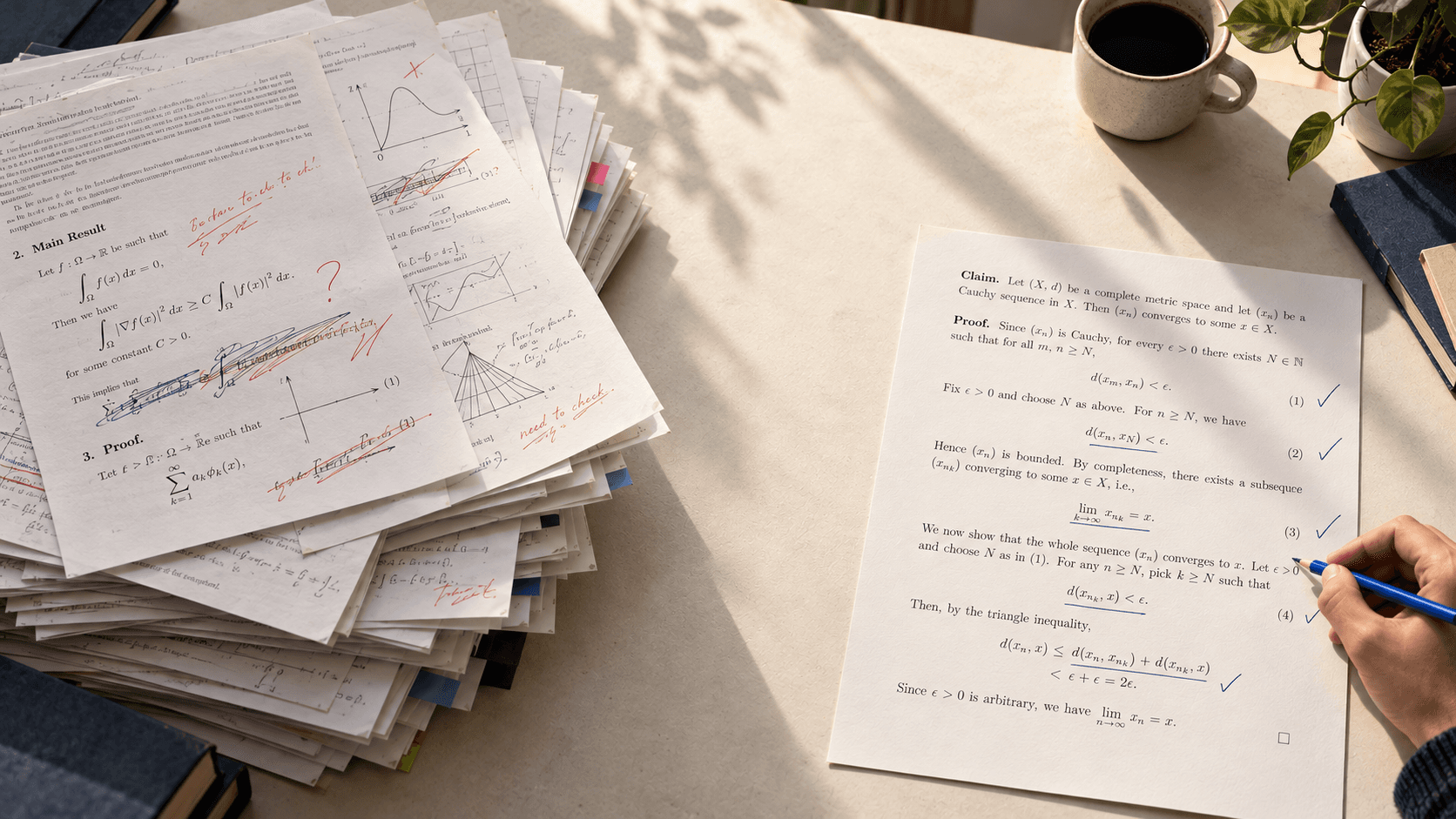
On October 6, 2026, OpenAI published 722 mathematical manuscripts produced by an internal frontier model, grouped into 372 families of results. The company also shared research details and formal proof resources for many of the results.
Then, the following day, three manuscripts were withdrawn because of a sign error, and 14 others were revised.
This is not a story about AI research being worthless. Nor is it proof that every remaining result is correct. It is a case study in a problem that will become increasingly important as AI produces more complex work: how do we distinguish a generated answer from a dependable result?
The breakthrough is only half the story
AI progress is often measured by what a model can produce: better answers, more code, higher benchmark scores, or more research results.
But production is not the same as validation.
A mathematical result must establish its conclusion through a sound argument. A business report must use the right data. A software change must work without creating new failures. A contract review must identify the relevant obligations rather than merely sound convincing.
The output can look polished and still be wrong.
OpenAI's release is notable because it combines a large body of generated research with a public repository, revision records, and formal proof resources. The repository makes it possible to inspect changes rather than treating every manuscript as a final, immutable document.
That matters. The correction history is not an embarrassing footnote to ignore; it is part of the evidence readers need to evaluate the work.
What Lean can and cannot verify
OpenAI says many proofs have been formalized in Lean, a proof assistant that allows mathematical statements and proofs to be checked by a computer.
The distinction is easier to understand with a simple analogy.
Suppose someone gives you a long calculation. You could read every line and try to find an error. Or you could encode the calculation in a system that checks each step against precise rules.
Formal proof systems make this possible for mathematical reasoning. They can catch logical gaps that are difficult to detect in natural-language explanations and make some results easier for other researchers to build upon.
But a proof assistant has a boundary.
It checks the formal statement and proof that it receives. It does not automatically establish that the formal statement captures the intended research question, that the paper explains the result clearly, or that all relevant prior work has been credited.
A computer can verify a proof of a proposition. Researchers must still understand what that proposition means and whether it supports the claim being made.
That is why formalization is an important verification tool, not a universal stamp of approval.
The corrections tell us something important
OpenAI's repository history records three withdrawals associated with a sign error in a manuscript about Weil classes. The error invalidated an argument and a construction used by two dependent papers. The repository also records revisions to 14 other manuscripts, including proof repairs and corrected statements.
The significance is not simply that mistakes happened. Research routinely involves corrections.
The important question is whether the system makes those corrections visible, explains their consequences, and preserves enough history for others to understand what changed.
In this case, the public repository documents the withdrawals and retains links to the earlier manuscripts. That gives readers a way to trace the change.
Still, the existence of a correction process does not settle the quality of every remaining result. Each claim must be assessed on its own evidence, and independent mathematical review takes time.
OpenAI has also said it plans to improve the presentation, exposition, and citations in future releases, while supporting workshops and other efforts to help researchers understand the work.
The broader lesson is that releasing knowledge at scale requires infrastructure for reviewing and maintaining it, not just generating it.
The same bottleneck is appearing in software
Consider what happens when an AI coding assistant generates a large amount of code.
The code may compile. It may even pass a basic test. But it could still contain a security vulnerability, misunderstand a requirement, or break a dependency elsewhere in the application.
The more code the system produces, the more important testing, code review, monitoring, and rollback become.
AI-generated research has a similar structure. More candidate results can accelerate discovery, but they also create more work for the people responsible for evaluating those results.
And the same principle applies to business automation.
An AI agent might update a CRM, reconcile customer records, prepare a financial report, or draft a contract. Generating the output is only one stage of the job.
Did the agent use the correct source? Did it change the right record? Was it authorized to take that action? Can the team trace what happened? Can the action be reversed if something goes wrong?
A capable model does not answer these operational questions by itself.
Five stages for more reliable AI workflows
Teams do not need to wait for perfect models to improve reliability. They can design better workflows around the models they use today.
- Generate. Let the model create a draft, calculation, or proposed action.
- Check. Use deterministic rules, automated tests, reconciliation, or formal verification wherever appropriate.
- Trace. Preserve inputs, source references, outputs, and version history so the result can be inspected later.
- Escalate. Route uncertain or high-impact decisions to a qualified human. The amount of oversight should reflect the consequences of being wrong.
- Learn. Record corrections and recurring failures, then improve the workflow to prevent similar mistakes.
The exact implementation depends on the task. Mathematical proof checking is not the same as validating a CRM update. But the architectural principle is shared: verification should be part of the workflow, not an afterthought added when something fails.
What this signals for AI agents
The next stage of AI adoption will depend on more than model capability.
It will depend on how well systems coordinate models, software tools, permissions, evidence, and human judgment. An agent that can act across several applications needs controls that make its work inspectable and its actions appropriately bounded.
For builders, this means storing evidence alongside outputs, maintaining version history, exposing failures, and designing recovery mechanisms.
For business leaders, it means evaluating an AI workflow by whether it reliably completes the job—not by how impressive a single demonstration looks.
For researchers, it means ensuring that the process of discovering results remains connected to the process of understanding and validating them.
Kovok's take: generation needs a control system
OpenAI's mathematics release is a useful case study because it combines technical ambition with a very practical challenge: how do we evaluate a large amount of AI-generated work without confusing volume with reliability?
The answer is not to stop generating. It is to build better systems around what gets generated.
A dependable AI workflow should make its outputs inspectable, preserve supporting evidence, expose uncertainty, and provide a clear path for correction. When an action carries meaningful consequences, it should also have appropriate permissions and human oversight.
The companies that benefit most from AI may not be those that produce the most output. They may be those that know what to trust, what to verify, when to intervene, and how to recover when something goes wrong.
Generation creates possibilities. Verification turns them into dependable work.
Sources
- OpenAI: Sharing AI progress in mathematics
- OpenAI mathematics repository
- Repository change history
- Retraction Watch: Three manuscripts withdrawn
- The Verge: Mathematicians respond to the release
Editorial note: The article distinguishes documented repository changes from independent validation of the remaining mathematical results.